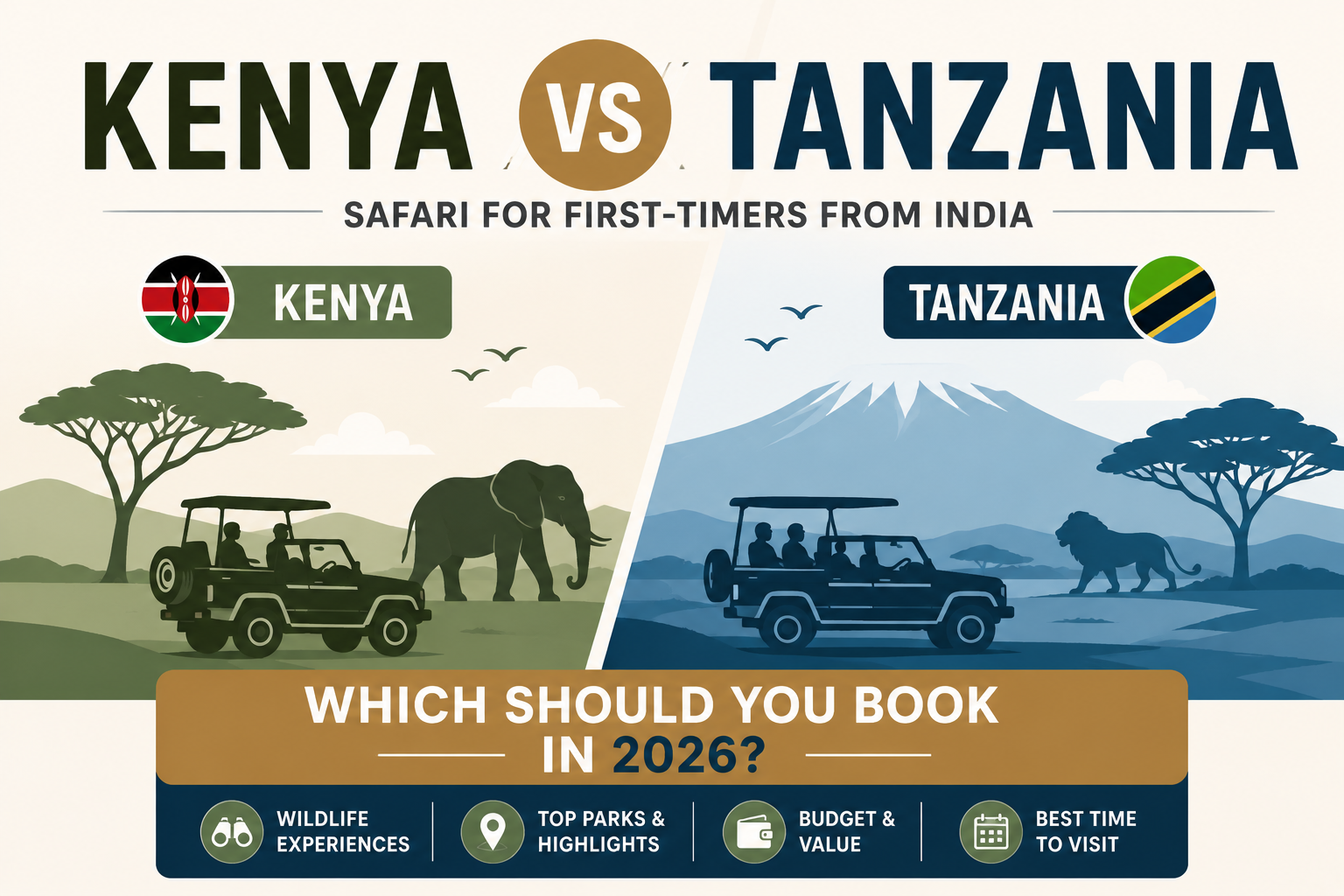
If this is your first safari, the Kenya-vs-Tanzania question usually gets answered with vague enthusiasm for both — which doesn’t help you book anything. The honest answer depends on three things that actually change your trip: when you’re traveling, how you’re getting there from India, and how much flexibility you want in your itinerary. Here’s how Travelexie, which runs its Kenya safaris with an on-ground team in Nairobi and Maasai Mara, would walk you through the decision.
Sample Itineraries Side by Side
Kenya — 6N/7D Nairobi & Maasai Mara
| Day | Location | What You’ll Do |
| 1 | Kolkata → Nairobi | Connecting flight, arrival, transfer to Nairobi hotel |
| 2 | Nairobi → Maasai Mara | Road or light-aircraft transfer, afternoon game drive |
| 3-4 | Maasai Mara | Full-day game drives, Mara River viewpoint, Maasai village visit |
| 5 | Maasai Mara → Lake Naivasha | Boat ride, Colobus monkey spotting en route |
| 6 | Lake Naivasha → Nairobi | Elephant orphanage/giraffe centre visit |
| 7 | Nairobi → Kolkata | Return flight |
Tanzania — 7N/8D Arusha, Serengeti & Ngorongoro
| Day | Location | What You’ll Do |
| 1-2 | India → Arusha | Connecting flight via Nairobi/Addis Ababa/Dubai, arrival, rest day |
| 3 | Arusha → Tarangire | Game drive, elephant herds and baobab landscapes |
| 4-5 | Serengeti | Full-day game drives, central or northern Serengeti depending on migration timing |
| 6 | Ngorongoro Crater | Full-day crater floor game drive, dense wildlife concentration |
| 7 | Ngorongoro → Arusha | Cultural visit, free time |
| 8 | Arusha → India | Return flight |
Great Migration Timing: This Decides More Than Anything Else
The wildebeest migration is a single continuous loop between Tanzania and Kenya, and where the herds are standing on your travel date should be the first thing you check, not an afterthought. From roughly January to June, the herds are concentrated in Tanzania’s Serengeti — first the southern plains for calving season (January-March), then moving through the western corridor by June, where the Grumeti River crossings begin. From July through October, the migration is in Kenya’s Maasai Mara, with the Mara River crossings — the dramatic, widely photographed moment of the migration — peaking in July and August, and continuing in smaller secondary crossings through September and October.
In practical terms: if you’re set on witnessing a river crossing and traveling July-October, Kenya is where the action is that season. If you’re traveling January-June, Tanzania’s Serengeti (plus the Ngorongoro Crater, which has resident wildlife year-round regardless of the migration) is the stronger choice. Booking Kenya in March expecting river crossings, or Tanzania in August for the same reason, is one of the most common first-timer mistakes.
Cost and Logistics from India
This is where Kenya has a real edge for Kolkata- and India-based travelers specifically. Nairobi has direct and one-stop connections from Indian metros (via Mumbai or Dubai, roughly 12-15 hours total from Kolkata), while Tanzania’s safari gateway airports — Kilimanjaro and Arusha — have far fewer India connections and usually route through Nairobi, Addis Ababa, or Dubai with a longer total journey. Visa-wise, Kenya’s eTA costs around $34 (about ₹2,900-3,000) and typically clears in 3 days; Tanzania’s e-visa runs closer to $50 and involves a similar online process. Neither is difficult, but Kenya’s flight connectivity from Kolkata is the more practical starting point if this is your first trip and you’d rather not lose a travel day to extra layovers.
On safari cost, Kenya’s Maasai Mara circuit and Tanzania’s Serengeti/Ngorongoro circuit land in a similar range once you match lodge category and season — Tanzania’s Ngorongoro Crater and central Serengeti lodges often run slightly higher due to conservation area fees layered on top of park fees. Travelexie’s Kenya packages start from ₹1,99,999 per person (6N/7D, flights and visa included); a comparable Tanzania circuit typically prices higher once Ngorongoro Conservation Area fees are added, given its longer itinerary and multi-park structure.
Why Book With Travelexie
For Kenya safaris specifically, Travelexie’s quotes are itemized by park fee, conservancy fee, lodge cost, and flight/visa charges — not bundled into one number that hides which season’s park fee you’re actually being charged. This matters most for a Kenya-vs-Tanzania decision because the two circuits price out differently once you add conservation area fees, and a vague combined quote makes it hard to compare them honestly. Because Travelexie’s team is on the ground in Nairobi and Maasai Mara, the Kenya side of this comparison reflects current conservancy access and vehicle availability, not a generic listing pulled from a rate card.
Practical Notes for Indian Travelers
Both circuits handle vegetarian requests reasonably well at established lodges, though Tanzania’s more remote Serengeti camps have less variety than Kenya’s Nairobi-Mara corridor, which sees far more Indian travelers. Malaria prophylaxis is advisable for both regions. If your itinerary connects through a yellow-fever-endemic country, carry your vaccination certificate — this applies to both Kenya and Tanzania entry. Tipping norms are similar across both countries, roughly $15-20 per day per guest for guide and camp staff.
Ready to Plan Your Trip?
If you’re still weighing which circuit fits your dates and budget, tell Travelexie when you’re planning to travel and what you most want to see — the Mara River crossings, the Ngorongoro Crater, or just a well-paced first safari — and you’ll get an itemized comparison instead of a generic sales pitch for whichever country the operator happens to sell harder.