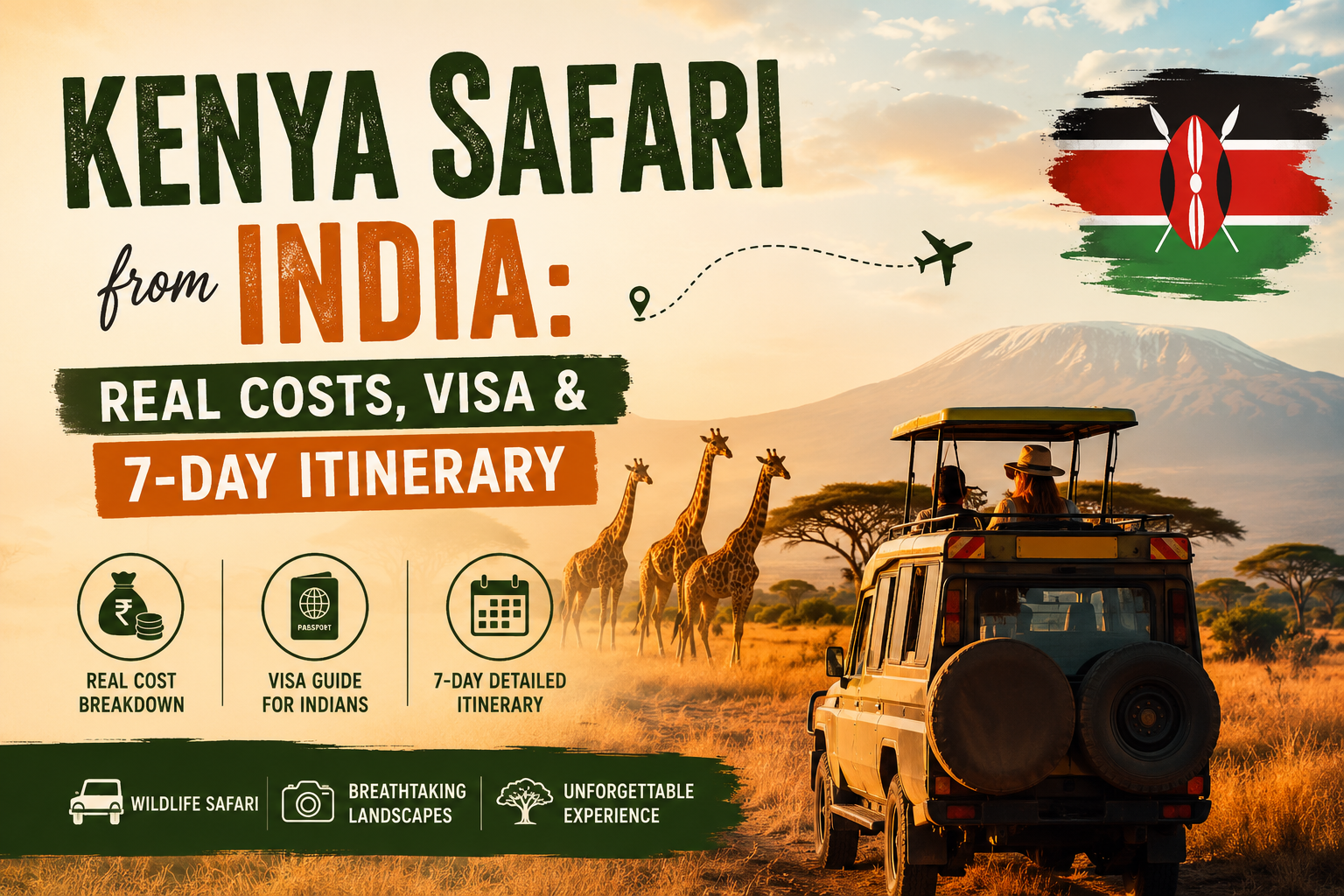
If you’ve been searching “Kenya safari from India cost” and getting numbers anywhere between ₹80,000 and ₹6,50,000 for what looks like the same trip, you’re not imagining it — Kenya safari pricing really does vary that widely, and most of the gap comes down to what’s quietly left out of the quote. Park fees, conservancy charges, and even international flights get bundled or excluded depending on the operator. At Travelexie, we build our Kenya itineraries around this exact problem: showing you what each line actually costs, so there’s no surprise invoice waiting at the lodge.
Day-by-Day Itinerary
| Day | Location | What You’ll Do |
| 1 | Arrive Nairobi | Land at Jomo Kenyatta International Airport (JKIA), transfer to hotel, evening at leisure |
| 2 | Nairobi → Amboseli (2N) | Drive to Amboseli National Park, afternoon game drive with Mount Kilimanjaro views |
| 3 | Amboseli | Full-day game drives — elephant herds, swamp-fed grasslands, sundowner at the lodge |
| 4 | Amboseli → Lake Nakuru (1N) | Drive via the Great Rift Valley viewpoint, afternoon game drive at Lake Nakuru |
| 5 | Lake Nakuru → Masai Mara (3N) | Transfer to the Mara, evening game drive on arrival |
| 6 | Masai Mara | Full-day game drive in search of the Big Five, optional Maasai village visit |
| 7 | Masai Mara → Nairobi → Departure | Morning game drive, drive back to Nairobi, transfer to airport for your flight home |
Best Time to Go
July to October is peak season — this is when the Great Wildebeest Migration crosses the Mara River, and it’s also when prices are highest, since park fees in the Mara nearly double during these months compared to the low season. January to March offers dry weather, good visibility, and noticeably lower park costs. If you’re flexible on dates and mainly want strong game viewing without migration-specific river crossings, the shoulder months (November–December, or April–May) bring real savings without a major drop in wildlife sightings.
Getting There from India
Kenya Airways flies direct from Mumbai to Nairobi in about 5.5 hours — the shortest and most convenient route for Indian travelers. From Delhi, there’s no direct option; you’ll connect through Mumbai, or route via Dubai or Doha on Emirates or Qatar Airways, which adds 3-4 hours but works well if you don’t mind a longer journey with a lounge break. Bengaluru, Chennai, and Hyderabad travelers typically connect through Mumbai as well. Round-trip international flights usually run ₹45,000–₹80,000 per person depending on season and how early you book — book early if you’re traveling in the July–October window, since fares climb fast.
For the visa, Indian passport holders need a Kenyan eTA, applied for online through the official eCitizen portal, typically approved within 24-72 hours at a cost of around $30 (roughly ₹2,500). Make sure your passport has at least six months’ validity from your date of entry, and note that a Yellow Fever vaccination certificate is mandatory for Indian travelers, so plan to get vaccinated at least 10 days before departure.
What This Trip Actually Costs
Here’s a realistic INR breakdown for this 7-day itinerary, per person, based on two people sharing:
- Budget tier (shared vehicle, comfortable tented camps): ₹1,80,000 – ₹2,50,000, including land package and domestic transfers
- Mid-range tier (private 4×4 with dedicated guide, semi-luxury camps): ₹2,80,000 – ₹3,80,000
- Luxury tier (fly-in options, private conservancies, premium tented camps): ₹4,50,000 and up
Add international flights (₹45,000–₹80,000 return), the eTA (~₹2,500), and a tipping budget of roughly $25-30/day for guides and camp staff. The one line item that trips up almost everyone comparing quotes is park and conservancy fees — Masai Mara charges around $80/day per person for non-residents, and Amboseli around $60/day, and these fees swing seasonally too. Some “budget” packages you’ll see online simply don’t include them, which is how a quote can look ₹40,000-50,000 cheaper than it actually is once you add these back in.
Why Book With Travelexie
This is exactly the gap Travelexie’s pricing is built to close. Every Kenya quote we send is itemized — flights, lodge nights, park and conservancy fees, meals, transfers, and visa costs are each shown as separate line items, not folded into one number. If a package doesn’t include Masai Mara’s park fees, we tell you that upfront and show you the actual cost of adding them, rather than letting you discover it after you’ve paid a deposit. We’ve seen too many Indian travelers get quoted an “all-inclusive” Kenya package that turns out to exclude exactly the fees that matter most. Travelexie’s itemized approach means the number we give you at the start is the number you’ll actually pay, plus your personal spends like tips and souvenirs.
Practical Notes for Indian Travelers
Vegetarian food is genuinely available at nearly every camp and lodge — Kenya has a large Indian community, and Nairobi’s Parklands area alone has more Indian restaurants than most first-time visitors expect. That said, “vegetarian available” on a lodge’s website doesn’t always mean dal-chawal on the buffet by default; tell Travelexie your dietary preferences when booking so we can flag it to each property in advance. For money, carry USD notes printed 2013 or later — Kenyan banks and lodges routinely reject older or worn bills, and Indian forex cards can be unreliable at remote safari camps, so keep $200-300 in cash as backup. For connectivity, a local Safaricom SIM (bought at JKIA arrivals, right after customs) works far better in the Mara than any lodge Wi-Fi or Indian international roaming.
Ready to Plan Your Trip?
If you’ve been going back and forth on Kenya because the pricing online never quite adds up the same way twice, that’s normal — it’s a genuinely confusing market to shop in. Send us your travel dates and group size, and Travelexie will put together an itemized quote for this exact itinerary (or a version tailored to your budget and interests), so you know precisely what you’re paying for before you commit to anything.